
Wow! The power of God! The calendar of ancient Israel was punctuated by divinely appointed feasts – times of joyous celebration, solemn remembrance, and profound spiritual significance. Among these, Sukkot (from Bible era Hebraicized Aramaic סכות = skwt = Sakwat, pronounced su-kwot) often called the Feast of Tabernacles or Booths, stands out as a vibrant week-long festival.
For followers of Jesus, understanding Sukkot not only connects us to our rich spiritual heritage but also illuminates glorious truths about our Savior.
What is Sukkot? The Old Covenant Roots
Sukkot is commanded in the Torah, primarily in Leviticus 23:33-43, Deuteronomy 16:13-15, and Numbers 29:12-38. These passages outline its purpose and practices:
"Speak to the people of Israel, saying, 'On the fifteenth day of this seventh month and for seven days is the Feast of Booths to the LORD... You shall dwell in booths for seven days. All native-born Israelites shall dwell in booths, that your generations may know that I made the people of Israel dwell in booths when I brought them out of the land of Egypt: I am the LORD your God.'" (Leviticus 23:33-34, 42-43)
The two primary meanings established in the Old Covenant are:
Commemoration of the Wilderness Wanderings: It serves as a historical reminder of God's miraculous provision and protection during the 40 years the Israelites wandered in the desert, living in temporary shelters (sukkot). It taught dependence on God.
Feast of Ingathering (Harvest Festival): It marks the completion of the annual agricultural harvest, particularly of grapes and olives. It was a time of thanksgiving for God's bounty and provision.
This dual significance highlights God as both Provider and Protector.
When is Sukkot Observed? (Modern Dates)
Sukkot is celebrated for seven days, beginning on the 15th day of the Hebrew month of Tishrei. In 2025, the dates are:
Begins: Sunset, Wednesday, October 8, 2025
Ends: Sunset, Wednesday, October 15, 2025
(Note: The eighth day, immediately following Sukkot, is Shemini Atzeret/Simchat Torah, which has its own unique observances.)
Traditional Jewish Foods for Sukkot
Food plays a central role in Jewish festivals, and Sukkot is no exception. Because the holiday emphasizes the harvest and agricultural bounty, meals often feature seasonal produce. Many traditional dishes symbolize hope for a sweet year or abundance.
Here are some common types of foods:
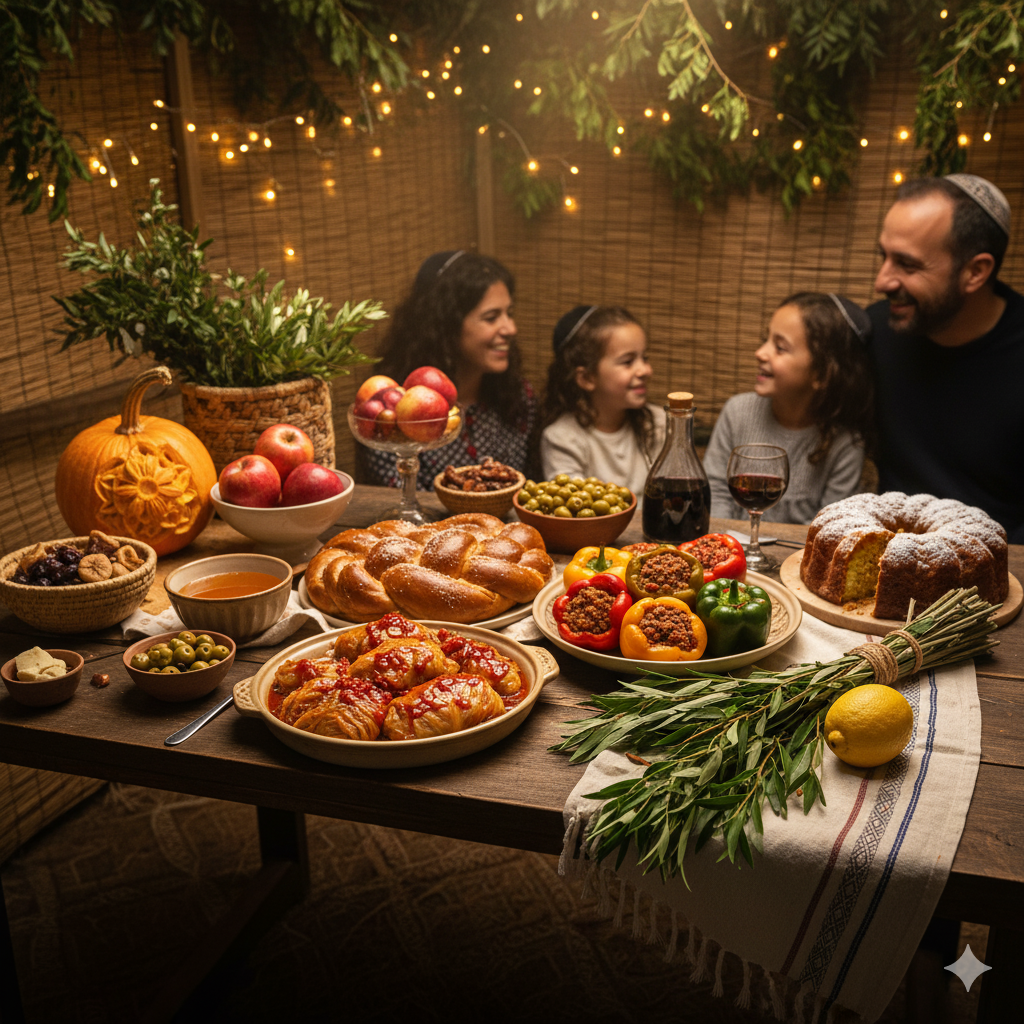
Stuffed Foods: Cabbage rolls (holishkes), stuffed peppers, and even stuffed challah (braided bread) are popular. These symbolize a bountiful harvest and are often made with sweet-and-sour sauces.
Harvest Produce: Dishes featuring gourds, pumpkins, apples, carrots, and other autumnal vegetables are common.
Sweet Dishes: Honey cakes, teiglach (honey-covered dough balls), and fruit compotes are enjoyed, often with cinnamon or ginger.
Dairy Products: While not exclusive to Sukkot, many families enjoy dairy dishes alongside or instead of meat during certain meals.
Dishes from the "Seven Species" of Israel: Wheat, barley, grapes (wine), figs, pomegranates, olives (oil), and dates (honey) are often incorporated into meals, as they represent the produce of the Holy Land mentioned in Deuteronomy 8:8.
Here's an example of a festive Sukkot meal spread, showing some traditional dishes and the presence of the Lulav and Etrog:
Sukkot and the New Covenant: Christ's Fulfillment
For believers in Jesus, Sukkot takes on a profound new layer of meaning, pointing directly to Christ's life, ministry, and future reign.
God Tabernacling Among Us (Past Fulfillment):
The most direct New Covenant connection to Sukkot is found in John 1:14: "And the Word became flesh and dwelt among us, and we have seen his glory, glory as of the only Son from the Father, full of grace and truth."
The Greek word for "dwelt" here is skēnoō, which literally means "to tabernacle" or "to pitch a tent." Jesus, the Son of God, literally "tabernacled" among humanity, fulfilling the very essence of Sukkot – God dwelling with His people.
Jesus as the Source of Living Water (Present Fulfillment):
During Sukkot, a significant ceremony involved drawing water from the Pool of Siloam and pouring it out at the Temple altar, symbolizing prayers for rain and the outpouring of the Holy Spirit (referencing passages like Isaiah 12:3). It was in this context that Jesus made an astonishing declaration:"On the last day of the feast, the great day, Jesus stood up and cried out, 'If anyone thirsts, let him come to me and drink. Whoever believes in me, as the Scripture has said, 'Out of his heart will flow rivers of living water.''" (John 7:37-38).
Jesus identified Himself as the ultimate source of spiritual refreshment and the fulfiller of the thirst-quenching symbolism of the Feast.
The Eternal Dwelling of God (Future Fulfillment):
Prophetically, Sukkot points forward to the ultimate and eternal dwelling of God with His people.
The Feast is often seen as a shadow of the millennial reign of Christ and the new heaven and new earth."Behold, the dwelling place of God is with man. He will dwell with them, and they will be his people, and God himself will be with them as their God." (Revelation 21:3).
This vision of ultimate peace, joy, and unbroken communion with God echoes the temporary booths of Sukkot, but now in permanent, glorious reality.
Should Christians Observe Sukkot? Opportunities to Share Jesus.
As Messianists, we understand that "Christ is the culmination of the law for righteousness to everyone who believes" (Romans 10:4). The Old Covenant feasts were "a shadow of the things to come, but the substance belongs to Christ" (Colossians 2:16-17). We are not commanded to observe Sukkot as a requirement for salvation or spiritual merit.
However, studying and even culturally participating in aspects of Sukkot can be immensely valuable:
Deeper Understanding of Scripture: It helps us appreciate the historical and cultural context of the Bible, enriching our understanding of Jesus' life and ministry.
Celebrating God's Faithfulness: It's an opportunity to remember God's faithfulness to Israel and His ongoing provision in our own lives.
Jesus’ teachings about inviting others to feasts and hospitality are deeply rooted in Jewish cultural and religious traditions, especially related to the sacred feasts and communal meals. Beyond the specific teachings in Luke 14 on inviting the poor and marginalized to banquets, other teachings and cultural practices offer insight into the meaning of such invitations during Jewish feasts.
These teachings deepen the meaning of Jewish feast invitations as not just cultural rituals but spiritual opportunities to live out God’s love and kingdom hospitality.
Evangelistic Opportunity for Jewish People:
1 Corinthians 9:20 (NKJV):
"And to the Jews I became as a Jew, that I might win Jews; to those who are under the law, as under the law, that I might win those who are under the law"
Understanding and respecting the spiritual significance of Sukkot for Jewish people provides a natural bridge for sharing the Gospel. Just as Jesus used the feast to declare Himself the Living Water, we can use the themes of God dwelling with humanity, divine provision, and future hope to point to Christ as the fulfillment of all these promises.
By explaining how Jesus is the tabernacle where God truly dwells among us, how He is the living water that quenches our spiritual thirst, and how His return will usher in an eternal Sukkot, we can respectfully and powerfully share the good news of Jesus with those who still observe the feast with Old Covenant understanding.
Sukkot, therefore, remains a rich tapestry of meaning – a beautiful reminder of God's past care, present grace, and glorious future, all centered on His Son, Jesus Christ.
Subscribe here for the latest articles..
To explore more core topics and resources, enter Our Holy Hub: Growing Gateways – Wells of Wisdom & Springs of Knowledge
Leave Your Comment Here