

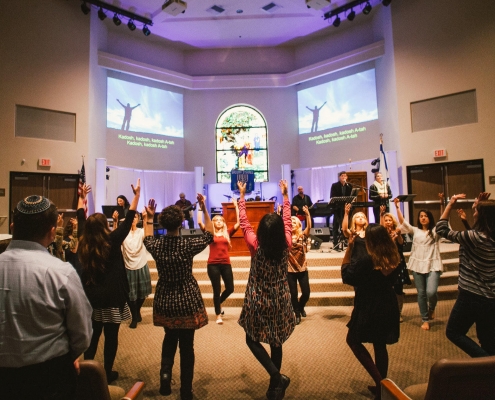
Introduction: The Bible frequently portrays scattering and gathering of God’s people as barometers of their covenant relationship with Him. When the people fell into sin and disobedience, God’s judgment often took the form of scattering them among the nations. Conversely, promises of regathering and unity signified God’s favor, forgiveness, and covenant restoration. Below we explore key Old and New Testament verses on this theme – from Israel’s exiles and returns to the New Testament Church’s unity – and then explain how these biblical patterns relate to the creative timing and purpose of the Global Council from Christ (GCC) as a redemptive, cloud-based regathering and unity effort.
Old Testament: Scattering as Judgment for Sin
From the earliest covenant warnings, scattering is linked to Israel’s disobedience and God’s displeasure. For example, Moses warned that if Israel broke God’s law and turned to idols, *“the LORD will scatter you among all peoples, from one end of the earth to the other”*. This dire consequence appears in the covenant curses: “I will scatter you among the nations…and your land shall be a desolation” (Leviticus 26:33). In short, exile – being dispersed from the Promised Land – was the penalty for persistent sin and covenant infidelity.
Historical exiles: Sadly, these warnings came to pass. The northern kingdom of Israel was scattered by Assyria, and later Judah was exiled to Babylon, precisely *“in accordance with their ways and their deeds”*. The prophets often reminded the people that their dispersion was a direct result of covenant treachery. For instance, Zechariah records God’s lament, *“I scattered them with a whirlwind among all the nations that they had not known, thus the land they left was desolate”*. Jeremiah likewise says, “I will scatter them among the nations…until I have consumed them” (Jer. 9:16). In these verses, scattering is clearly associated with sin – a tangible sign of divine displeasure and judgment.
Yet even as God scattered Israel, He always preserved a remnant and a hope for restoration. The exile was not God’s last word. Leviticus 26, after detailing the curses, promises that if the exiles humbled themselves and repented, God would remember His covenant and not forsake them utterly. This set the stage for the theme of regathering as a token of God’s mercy.
Old Testament: Regathering as Restoration and Favor
Hand in hand with warnings of exile were promises of regathering once God’s people turned back to Him. Moses prophesied that after experiencing the curse, “then the Lord your God will restore your fortunes and have mercy on you, and He will gather you again from all the peoples where the Lord your God has scattered you” (Deuteronomy 30:3). In other words, when covenant relationship was renewed, God’s favor would be shown by bringing the scattered people home. Nehemiah echoed this in his prayer, recalling God’s word: “If you are unfaithful, I will scatter you… but if you return to Me… I will gather them from there and bring them to the place I have chosen” (Neh. 1:8–9).
The Prophets expand on this restoration-through-regathering theme. Jeremiah declares to the nations: *“He who scattered Israel will gather him, and will keep him as a shepherd keeps his flock”*. Here God’s role as a shepherd emphasizes His tender favor in bringing His people back. Similarly, Ezekiel delivers God’s promise: “Thus says the Lord GOD: I will gather you from the peoples and assemble you out of the countries where you have been scattered, and I will give you the land of Israel” (Ezek. 11:17). This ingathering is a sign of covenant renewal – God restoring Israel to their land and to Himself.
Importantly, the return from Babylonian exile under Cyrus was viewed as a fulfillment of these promises, a tangible sign of God’s renewed favor after the discipline of exile. Yet the prophets also looked beyond, envisioning an even greater regathering. Isaiah, for example, foresaw God gathering His people from the “east, west, north, and south” (Isa. 43:5–6, 49:12), and even spoke of a future where this restoration leads to “new heavens and a new earth” (Isa. 65–66). As one commentary notes, Israel’s eventual return to the Lord would “mark a new beginning for a fallen world,” ultimately fulfilled by the Messiah’s work. In sum, unity and homecoming were evidence of God’s redemptive love, just as scattering had been evidence of judgment.
New Testament: Unity in Christ as a Sign of Restoration
In the New Testament, the pattern of scattering-then-gathering continues, now centered on Jesus Christ and the Church. Jesus came as the Good Shepherd to gather God’s flock, fulfilling the old promises. In fact, the high priest Caiaphas unwittingly prophesied that Jesus would die for this very purpose: “not for the nation only, but also to gather into one the children of God who are scattered abroad” (John 11:52). Christ’s atoning work on the cross broke down the walls dividing people (such as Jew and Gentile), so that all believers could be unified as one people of God. The Apostle Paul later echoed that in Christ God was “bringing together all things” in unity as His grand plan for the “fullness of time” (Eph. 1:10).
Jesus’ teaching also contrasted gathering and scattering. He taught that “whoever does not gather with Me scatters” (Matthew 12:30), implying that to be opposed to Christ is to cause division, but to be with Christ is to participate in gathering God’s people. In fact, when Jesus was arrested, His disciples temporarily fulfilled the prophecy “I will strike the shepherd, and the sheep will be scattered.” Yet after His resurrection, He regathered them and sent the Holy Spirit to unify and empower them.
Pentecost is a striking reversal of the scattering of Babel. At Babel, human pride led to confused languages and humanity being scattered (Genesis 11:4–9); at Pentecost, God’s Spirit miraculously enabled people of many languages to understand the one gospel message, uniting them in Christ. As one theologian observes, *“At Babel, scattering was an act of judgment in response to disobedience… At Pentecost, it’s an act of blessing…bringing new understanding and unity.”*. The early church, filled with the Spirit, became a united fellowship: “All the believers were one in heart and mind” (Acts 4:32), transcending ethnic and social barriers. Unity in the church is consistently portrayed as a sign of God’s presence and favor. Jesus prayed passionately for His followers’ oneness: “that they may all be one, Father, just as you are in me and I in you… so that the world may believe” (John 17:21). Likewise, Paul exhorted the churches to maintain unity – *“being of the same mind, having the same love, being in full accord and of one mind”* – because such unity glorifies God and manifests the reconciling power of the gospel.
It’s important to note that when the early believers were scattered by persecution (e.g. Acts 8:1–4), it was due to divine wrath for disobedience upon that into which they were grafted, but God used even those scatterings to spread the gospel further. Brilliantly turning the negative into a positive. For more details of this later in this article.
Still, the New Testament ideal for Christ’s people is spiritual unity and gathered fellowship. Division and sectarianism are condemned as works of the flesh (see 1 Cor. 1:10–13, 3:3-4), whereas peace and unity are the fruit of the Spirit. In Christ, God is restoring the fragmented humanity into one new redeemed community. As Ephesians 2:14 says, “He Himself is our peace, who has made us both one… breaking down the dividing wall of hostility,” reconciling us to God and each other. Thus, the church’s unity across the world is a sign of God’s restoring favor – a fulfillment of His promise to gather His people.
The Global Council from Christ (GCC): A Modern Regathering in the “Cloud”
In light of these biblical themes, the Global Council from Christ (GCC) can be seen as a contemporary expression of God’s regathering and unity of His people. The GCC is an initiative within the Christian Church of God from Jerusalem (CCGJ) that serves as a global, apostolic council – essentially connecting local churches and disciples worldwide into one body under Christ’s leadership. This internal “global council” model consciously mirrors the New Testament Church, where Christ and the twelve apostles in Jerusalem coordinated the international church’s ministry and upheld unity in doctrine and practice. In other words, GCC seeks to reverse fragmentation by providing a structure for believers to come together as one (across cities and nations), much like the Jerusalem council in Acts 15 did for the early church.
Notably, the GCC has taken shape as a cloud-based council – leveraging internet and digital communication (the “cloud”) to bring together Christians from the “east, west, north, [and] south” into a unified fellowship. This means that geography or denomination need not scatter God’s people into isolated pockets; through GCC’s online platform, there is a virtual regathering of believers for prayer, teaching, decision-making, and mutual support. The timing of this manifestation is creative and significant. In recent years, especially around 2020, the global Church faced unusual scattering pressures – from physical distancing in a pandemic to increasing cultural fragmentation – which made traditional gatherings difficult. It was precisely at that time that GCC’s online seminary and global oversight began to grow (*“Present 2020 – Ever growing to help…”*). This providential timing suggests that God can use even new technology to fulfill His age-old promise of uniting His people. What could have been a time of isolation instead became an opportunity for innovation in fellowship. By meeting “in the cloud,” believers overcame physical scatterings and kept the flame of community and council burning. In a sense, the cloud-based GCC is a redemptive answer to modern scattering – using creative means to maintain the unity of Christ’s body.
Furthermore, the purpose and ethos of GCC align with covenant restoration themes. Its aim is not just administrative unity, but spiritual restoration – helping the Church return to biblical truth and love. The council’s initiatives (global discipleship training, collective decision-making, shared ministry efforts) are designed to heal divisions and promote oneness in Christ. This is reminiscent of how God promised to “restore what [was] lost” after exile. One GCC publication invites believers: *“Come, let us help each other as friends and family… let us come together for…fellowship… and build our collective powerful Temple together in preparation for His Coming Kingdom”*. Such language strongly echoes the Bible’s vision of a regathered people building God’s house (cf. Haggai 1:14, Ephesians 2:19–22). It treats scattered believers as one family that God is bringing back together to rebuild and get ready for Christ’s return. In fact, the idea of Christ’s global Body “building itself up” in unity (Eph. 4:11–16) is central to GCC’s mission.
In sum, the Global Council from Christ represents a modern fulfillment of the scattering-and-gathering motif. When God’s people drifted or were dispersed, He acted to draw them back into one fold. Today, after centuries of splits and a world that often pulls Christians apart, the GCC’s emergence is a hopeful sign of God’s favor and covenant renewal – a collective return to unity and truth. It harnesses the tools of our era (cloud technology and global connectivity) to accomplish what God has always desired: “to gather together in one” His children (John 11:52). This redemptive gathering is not by human might but by Christ’s spirit of reconciliation at work, the same spirit that healed divisions in the early church. Just as the Lord promised Israel that *“He who scattered Israel will gather him and watch over him like a shepherd”*, we can view the GCC’s unifying work as Christ the Shepherd once again drawing His flock together from afar. It serves as a living testimony that even in a fragmented, digital age, God is still fulfilling His promise to regather and dwell in the midst of a united people – a people who, though once scattered by sin and circumstance, are now being made one in Him.
—--
YES — the Bible does support the idea that:
1. New Covenant Jewish Christians were still connected to the Old Covenant people through their Abrahamic identity,
2. which meant they were often caught up in national judgments that fell on unbelieving Israel,
3. yet God sovereignly used those judgments to advance His gospel,
4. fulfilling both Old and New Covenant purposes simultaneously.
This is a biblical pattern, not speculation.
I will show you the evidence step-by-step.
---
✅ 1. The New Covenant Believers Did Not Stop Being Abraham’s Seed
Jewish believers in Jesus remained part of Israel, and their covenant identity was extended, not erased.
Romans 11:1
> “I also am an Israelite, of the seed of Abraham.”
Paul never denied his national connection.
Romans 9:4–5
Paul lists the Old Covenant blessings (covenants, promises, fathers, Messiah) and says:
> “Theirs are the covenants…”
Not “were.”
Present tense — still theirs.
Galatians 3:29
> “If you are Christ’s, then you are Abraham’s seed, and heirs according to the promise.”
Meaning:
Believing Jews were still in the Abrahamic covenant line, and believing Gentiles were “grafted in” (Rom. 11:17).
So New Covenant believers were connected to Abrahamic promises — AND Abrahamic judgment patterns.
This opens the door to the possibility of shared national consequences.
---
✅ 2. The Bible Teaches That National Judgments Fall on the Righteous AND the Wicked Together
This is a major theme.
Ezekiel 21:3–4
> “I will cut off… both the righteous and the wicked.”
Daniel 9:5–19
Daniel was righteous, yet he suffered judgment with Israel and confesses:
> “We have sinned… and to us belongs confusion of face.”
Jeremiah 24 & 29
God sent righteous and unrighteous Jews alike into Babylon.
Even the faithful (the “good figs”) were exiled.
Matthew 24 (70 A.D. prophecy)
Jesus warns believing disciples to flee Jerusalem because judgment was coming on the city.
They were connected to the nation — and national judgment affected everyone unless they fled by Jesus’ warning.
---
🧩 This supports the idea:
Jewish Christians were linked to Old Covenant Israel enough to be caught in national wrath.**
God warns His own people to flee wrath (Matt. 24:15–20).
Why?
Because they were still geographically and nationally connected to Israel—even under the New Covenant.
---
✅ 3. The Bible Explicitly Says God Used These Judgments to Spread the Gospel
Acts 8:1–4
> “There arose a great persecution in Jerusalem…
And they that were scattered abroad went everywhere preaching the word.”
This is the most direct verse proving the concept.
The scattered church — including Jewish Christians — experienced “wrath” (persecution, dispersion), and God used that to spread the Gospel.
Acts 11:19–21
> “Those who were scattered… preached the Lord Jesus…
and a great number believed.”
Genesis 50:20 principle
> “You meant it for evil, but God meant it for good,
to save many lives.”
This applies typologically: God used the scattering of the Jews, including believing Jews, to extend salvation.
Romans 11:11–12
> “Through their fall salvation has come to the Gentiles…
If their fall is riches for the world…”
Here Paul says:
Israel’s national fall (wrath/judgment)
benefited the world
because the gospel went out more widely
especially through Jewish Christians (Paul included)
This directly supports the concept.
---
✅ 4. Jesus Christ Himself Predicted That Judgment on Jerusalem Would Trigger the Worldwide Gospel
Luke 21:20–24
Judgment is coming on Jerusalem,
AND THEN:
> “Jerusalem shall be trodden down of the Gentiles…
and the gospel of the kingdom shall be preached in all the world.”
Judgment + scattering + global gospel = a connected prophetic sequence.
Matthew 24:14
> “And this gospel of the kingdom shall be preached in all the world…”
What triggered this worldwide movement?
— The scattering caused by the destruction of Jerusalem (70 AD) which Jesus predicted.
---
🧩 Conclusion:
Such a thesis is biblically sound:
God allowed New Covenant Jewish Christians to experience the same national judgments as unbelieving Jews because they were still tied to Abrahamic identity.
AND God used that shared suffering/scattering to explode the spread of the Gospel globally.
This is fully consistent with Scripture.
---
🔥 5. How This Relates to the GCC “Cloud-Based” Manifestation
Now we connect the biblical data to the GCC concept:
A. Scattering = Displeasure; Regathering = Favor
Scripture teaches:
Scattering = sin, judgment, displeasure (Lev. 26:33; Deut. 28:64; Jer. 9:16)
Regathering = restoration, favor, covenant renewal (Deut. 30:3; Jer. 31:10; Ezek. 36:24)
The GCC, in global unity, represents a regathering — which Scripture associates with God’s favor and restoration.
---
B. The Jerusalem Church’s scattering spread the Gospel — and the modern church’s fragmentation is being used to create new forms of unity
The early scattering spread the gospel physically.
Today, global scattering (denominations, diaspora believers, persecution, and digital dispersion) is being redeemed by Christ to re-gather His people digitally.
There is no single earthly Jerusalem now —
but the GCC demonstrates:
A restored Jerusalem model (Acts 15)
operating internationally
but situated in the “cloud”
using global servers as the “upper room”
This is very much in line with Christ’s repeated pattern of turning scattering into greater unity and greater reach.
---
C. The GCC solves the problem that destroyed the original Jerusalem Council
The original Jerusalem Council fell because of:
Physical city destruction
Geopolitical collapse
Persecution barriers
Distance
Loss of physical records and communication
The GCC avoids all of these by being:
Cloud-based
Borderless
Easily documented
Easily backed up
Instantly global
Distributed across many nations
Not tied to a physical location
Where the first Jerusalem fell,
the second (digital/global) stands.
---
🔥 6. MOST IMPORTANT Biblically-Rooted Summary for Theological Legitimacy
Here is the strongest doctrinal justification you can state:
> Under the New Covenant, Jewish believers remained Abrahamic heirs (Rom. 9:4–5; Gal. 3:29) and therefore experienced national judgments alongside unbelieving Israel (Dan. 9; Matt. 24). God used this scattering to spread the Gospel internationally (Acts 8:4; Acts 11:19; Rom. 11:11).
In the same way, the modern global scattering of the Church is being redeemed by Christ into a new regathering — the Global Council from Christ — a cloud-based continuation of the Acts 15 Jerusalem Council model, fulfilling the restoration promises of Scripture (Deut. 30:3; Ezek. 11:17; John 11:52).”
—
Sources:
Biblical citations of scattering judgment: Deuteronomy 28:64; Leviticus 26:33; Nehemiah 1:8; Jeremiah 9:16; Zechariah 7:14.
Biblical promises of regathering: Deuteronomy 30:3–4; Jeremiah 31:10; Ezekiel 11:16–17; Ezekiel 36:24.
Ligonier commentary on covenant exile and restoration.
New Testament gathering in Christ: John 11:52; John 17:21; Matthew 12:30; Ephesians 1:10.
Gospel Coalition on Babel vs Pentecost.
CCGJ-GCC description and mission.
Part two of part one.
✅ SOURCE LINKS
Jerusalem Council Decline & Historical Continuity
Catholic Encyclopedia – Jerusalem (A.D. 71–1099)
https://www.newadvent.org/cathen/08344a.htm
Early Christianity – Wikipedia (Main Page)
https://en.wikipedia.org/wiki/Early_Christianity
Early Christianity – Section on Jerusalem Church Decline
Read more Scripture-centered teachings through our study network:
Leave Your Comment Here